


Atmospheric physics, which is the branch of physics dealing with physical phenomena that occur in the atmosphere, falls within the so-called Earth System Sciences.
The areas of physics involved are diverse and, by way of example, we can mention:
- Classical mechanics (inertial systems, reference frame-related forces);
- Hydrodynamics (equations of fluid motion);
- Transport phenomena (particle diffusion);
- Thermodynamics (thermodynamic state, phase transitions);
- Quantum mechanics (radiation-matter interactions, chemical processes).
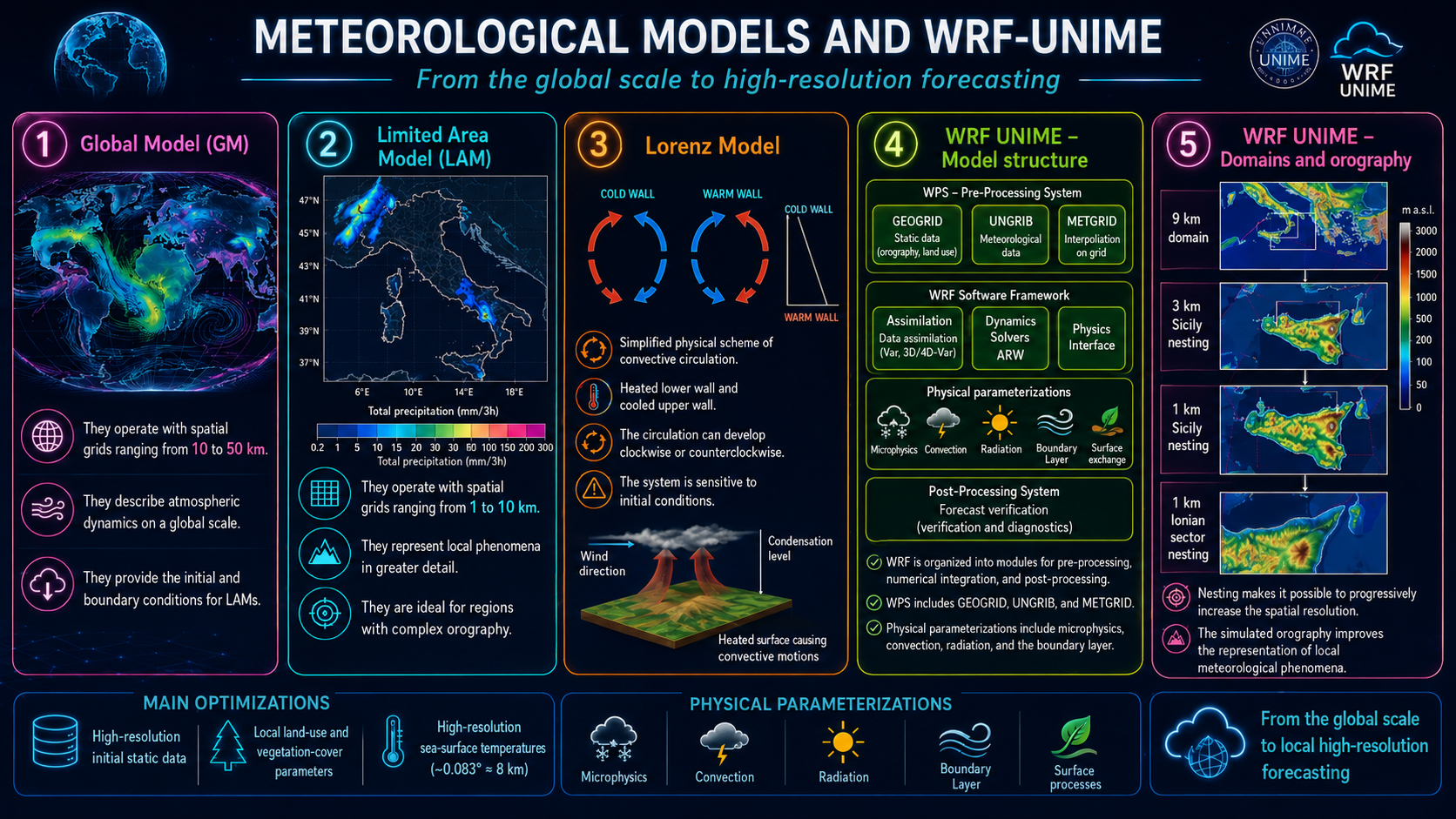
The Strait of Messina area is a very important natural laboratory for studies related to meteorology. It represents one of the areas in the world that present particular difficulties in weather forecasting for various reasons, such as its complex geographical position and peculiar orography.
The territory is in fact surrounded by two seas with different characteristics and a high thermal gradient, while the presence of mountain ranges overlooking the coasts, characterized by steep slopes, contributes to making local atmospheric dynamics particularly complex.
Furthermore, the presence of volcanic ash, released into the atmosphere by active volcanoes such as Stromboli and Etna, actively contributes to the nucleation processes of hydrometeors and can act as an accelerator in the genesis processes of cumuliform systems.
Within this framework, two distinct physical-mathematical models have been made operational concerning:
- Weather forecasting
- Air quality
Finally, innovative physical methods are used to perform analyses on climate change, with particular reference to the regional territory of Sicily.