

The research activity in the domain of the history of physics is inscribed within a markedly interdisciplinary epistemological horizon, in consonance with Ervin Laszlo's reflection, according to which disciplines constitute conceptual constructions that are necessary but intrinsically limiting with respect to the complexity of reality. From this perspective, disciplinary boundaries, far from being ontologically founded, are configured as flexible heuristic devices, susceptible to continuous redefinition, according to a vision that finds an echo in William Shakespeare's famous intuition regarding the inexhaustible richness of the natural world compared to our interpretive categories.
In coherence with the guidelines promoted by the Consortium, the scientific activity is articulated along a path that organically intertwines the history of physics, educational reflection, and the valorization of scientific-material heritage, configuring the historical discipline not merely as an erudite reconstruction, but as a critical tool capable of questioning the processes of genesis, transmission, and transformation of scientific knowledge. In this framework, the history of physics assumes a leading epistemological function, posing itself as a privileged domain for the analysis of theoretical models and experimental practices, as well as their cultural and social implications.
Particular attention is paid to the contextual dimension of learning processes, within which the territory is configured as a true, widespread historical-scientific laboratory. In it, material culture, traditional technologies, and historically determined technical devices present themselves as cognitive mediators, capable of rendering physical concepts intelligible and concretely experiential, fostering learning deeply rooted in the contexts of knowledge production. This approach makes it possible to overcome the traditional fragmentation of educational paths, promoting an integrated and systemic approach, in which knowledge is recomposed within a coherent and meaningful framework.
Furthermore, a privileged area of reflection is the relationship between physics and mathematics, disciplines that are formally distinct but structurally interdependent. The critical issues arising from their separate treatment in academic curricula are addressed through an approach that combines historical and epistemological dimensions, highlighting the profound correspondences between theoretical structures and analytical tools. What emerges is a vision of the history of physics as a space for the integration of knowledge, capable of acting as a hinge between disciplinary fields and guiding the development of innovative teaching models, founded on the connection, contextualization, and globalization of scientific knowledge.
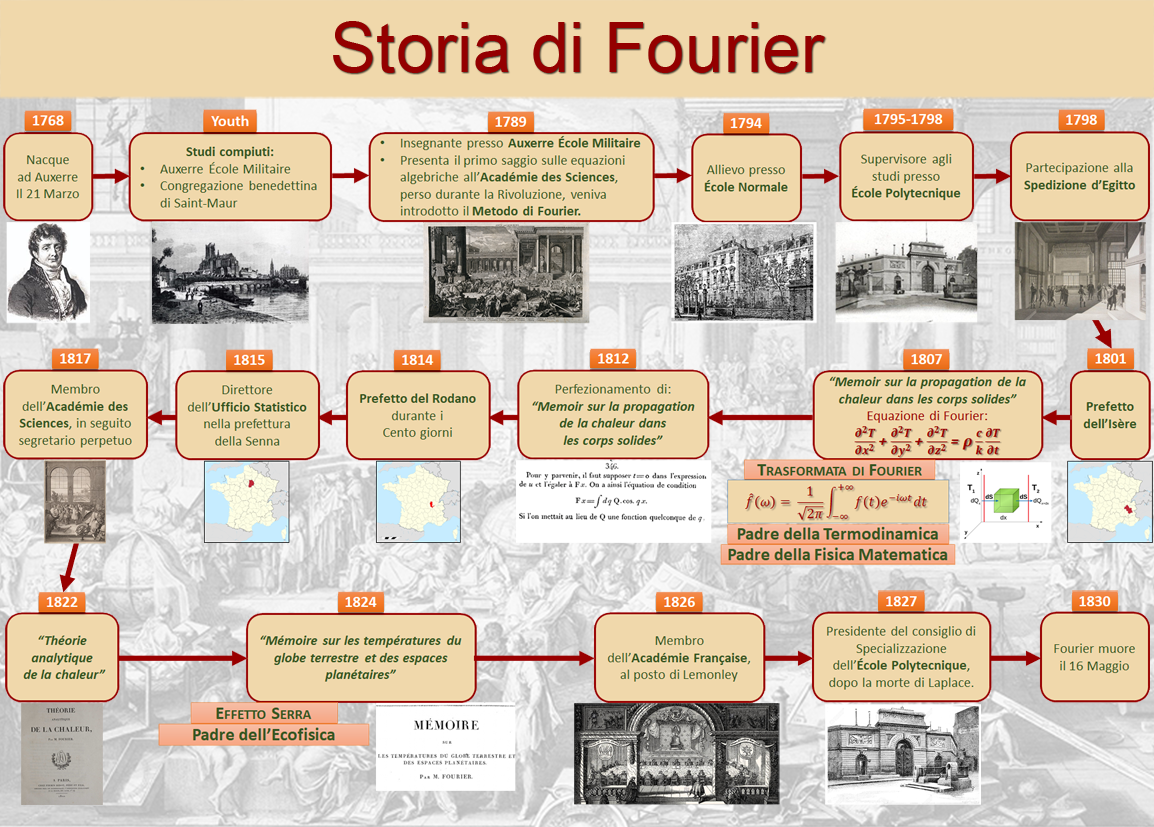
An example is provided by the following Graphical Abstract, relating to a work in which it was chosen to proceed using a historical approach, retracing the phases of Jean-Baptiste Joseph Fourier's scientific contribution starting from the historical-political and socio-cultural context and from the reconstruction of the character. For the historical reconstruction, various documents from the era and beyond were used, seeking to provide the reader with all the necessary elements to understand and contextualize J. Fourier's nature and psyche within the historical framework, elements that have always shown a parallel with his activity as a scientist.