

Complex systems represent one of the most fascinating and profound areas of contemporary physics, characterized by the presence of a large number of interacting components, whose collective dynamics cannot be reduced to the simple sum of individual behaviors. In such systems, macroscopic properties emerge - often unexpected - that cannot be directly deduced from microscopic laws, giving rise to phenomena of self-organization, criticality, and hierarchical structures.
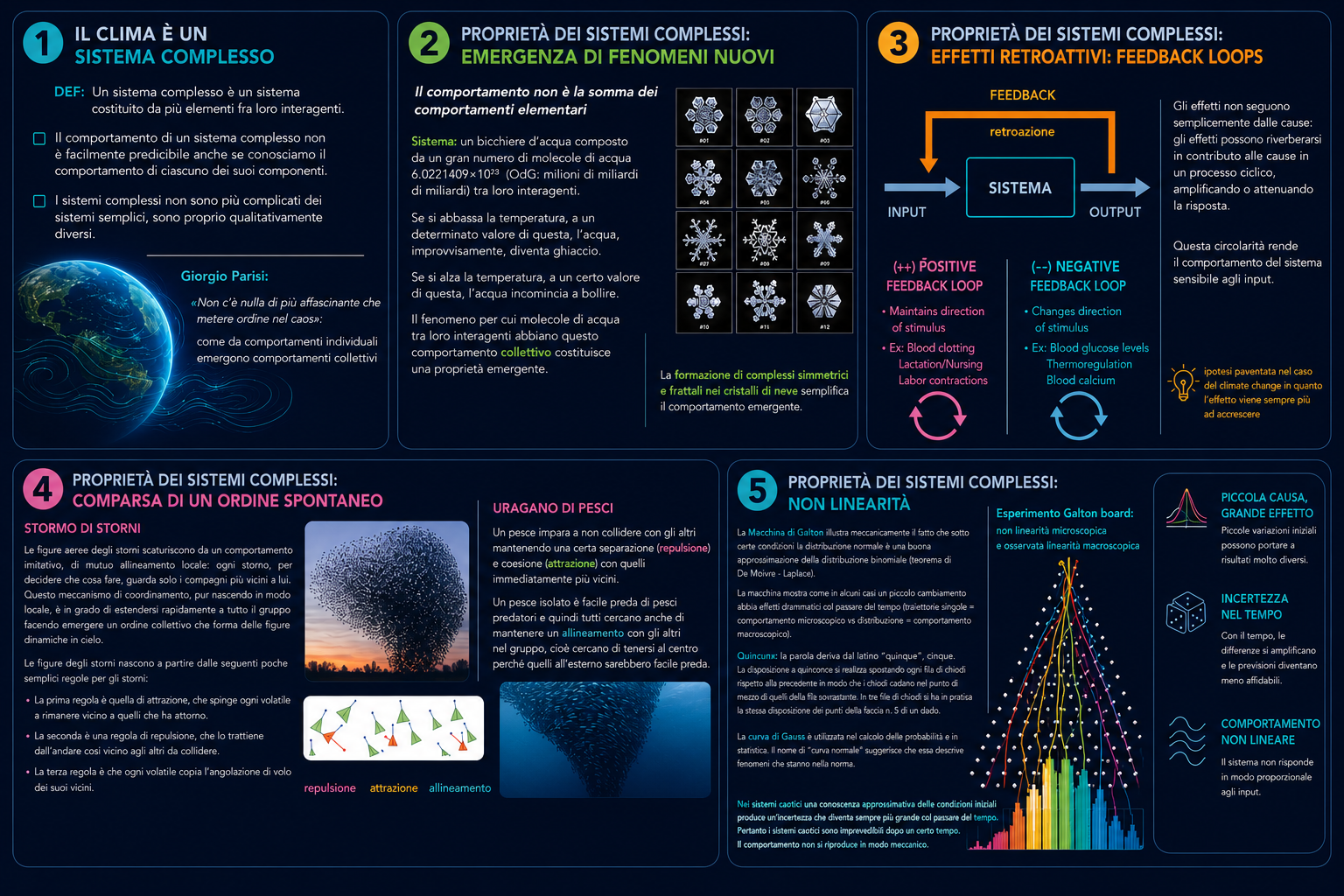
A key element in the study of complex systems is the role of fluctuations and disorder. As highlighted by the work of Giorgio Parisi, understanding the interaction between these two aspects has allowed the development of a theoretical framework capable of describing seemingly chaotic systems, such as disordered materials (e.g., spin glasses), but also phenomena on a much larger scale. In such contexts, disorder is not simply a perturbation, but a structural component that helps define the global behavior of the system.
Around the 1980s, Parisi identified the existence of hidden patterns in complex systems, showing how multiple and metastable configurations can coexist and how the dynamics of the system develops over a highly irregular energy landscape. This approach revolutionized statistical physics, introducing theoretical tools capable of tackling non-ergodic and strongly correlated systems.
The importance of these results transcends the boundaries of traditional physics. The concepts developed for disordered systems find application in extremely diverse fields, from mathematics (optimization theory and combinatorial problems), to biology (neural networks and evolutionary systems), to the study of climate and neuroscience, where the complexity of synaptic connections and brain dynamics requires models capable of describing emergent collective behaviors.