


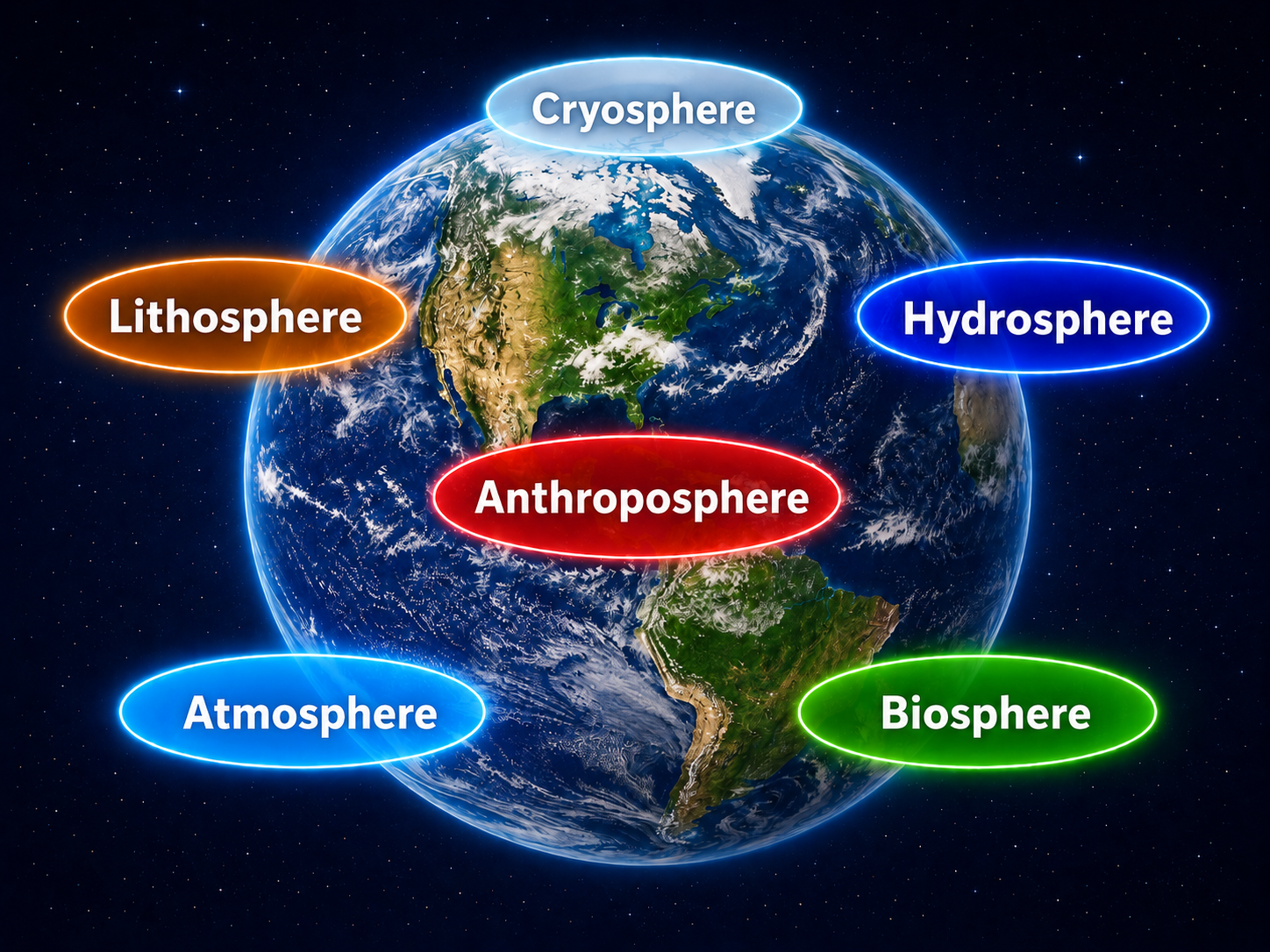
The Earth's climate system constitutes a paradigmatic example of a complex system, being formed by multiple subsystems — atmosphere, oceans, cryosphere, biosphere, and lithosphere — which interact with each other through continuous exchanges of energy, mass, and momentum.
These interactions occur on extremely different spatial and temporal scales, making the global behavior of the climate irreducible to the simple sum of the dynamics of its individual components. Even a detailed knowledge of the laws governing each subsystem is not sufficient to accurately predict the overall evolution of the climate system.
A fundamental characteristic of the climate is indeed the presence of fluctuations, instabilities, and non-linear processes, which give rise to emergent phenomena and often unpredictable dynamics.
The climate is not simply a “complicated” system, but a qualitatively different one, in which collective behavior emerges from an intricate network of interactions.
In this context, the parametric resonance model offers an innovative perspective for understanding certain characteristics of climate variability.
In physical systems, parametric resonance occurs when an internal parameter of the system — for example, a natural frequency or a coupling coefficient — varies over time in such a way as to selectively amplify certain oscillations.
Transposed to the climate system, this concept suggests that the different climate components can interact by mutually modulating their dynamic parameters, generating amplification phenomena and energy transfer between different scales.
Periodic variations of external parameters, such as solar irradiance or the Earth's orbital conditions, can modulate the climate system in a way that favors the emergence of characteristic climate cycles.
The parametric resonance model also allows the climate to be interpreted as a system in which multiple coupled oscillatory modes coexist, each characterized by its own frequencies and amplitudes.
The interaction between these modes can give rise to phenomena of synchronization, interference, and energy transfer, contributing to the formation of complex climate patterns.
In this framework, seemingly chaotic events can be reinterpreted as the result of resonant dynamics between different components of the system.
Finally, the introduction of models based on parametric resonance also opens new perspectives for climate forecasting.
While not eliminating the intrinsic uncertainty of complex systems, these models can help identify the conditions under which the system is particularly sensitive to certain perturbations, improving the understanding of amplification processes and transitions between different climate states.