


The human brain can be interpreted as a highly complex dynamic system, in which electrical activity emerges from the collective interaction of a vast number of neurons.
In this context, the description of brain phenomena requires theoretical tools capable of capturing not only the local properties of individual elements but, above all, the global dynamics established at the network level.
The parametric resonance model of the brain fits into this perspective, proposing an innovative interpretative key to understand the structure and evolution of neuronal oscillations.
Brain electrical activity manifests through well-defined frequency bands — delta, theta, alpha, beta, and gamma — each associated with specific functional states, ranging from deep sleep to the most complex cognitive processes.
A particularly relevant aspect is that the central frequencies of these bands are not randomly distributed but show a quasi-hierarchical structure, suggesting the existence of coupling mechanisms between different temporal scales of neuronal activity.
The model assumes that this organization is the result of selective amplification processes analogous to those observed in physical systems subject to parametric excitation.
Transposing this concept to the brain, it is hypothesized that interactions between neuronal populations can dynamically modulate the system's own frequencies, favoring the emergence of stable and coherent oscillatory patterns.
A central element of this approach is neuronal synchronization, namely the tendency of groups of neurons to oscillate in phase or with well-defined phase relationships.
The model suggests that parametric resonance may constitute the physical mechanism underlying this phenomenon, allowing the efficient transfer of energy between different frequency bands and facilitating the hierarchical organization of oscillations.
To operationally illustrate the theoretical framework introduced, a case study was considered based on the spectral analysis of EEG signals recorded during transitions between wakefulness and sleep.
The recordings used come from the open-access database ANPHY-Sleep ( DOI: 10.17605/OSF.IO/R26FH ), which collects high-density polysomnographic data acquired from healthy subjects.
Human sleep is structured into different physiological stages, characterized by specific neuroelectrical and functional dynamics. In particular, the NREM sleep phases (N1, N2, and N3) and the REM phase, associated with intense brain activity and a higher probability of dreaming, are distinguished.
EEG signal processing was performed using Fourier analysis, focusing mainly on the occipital channels O1, O2, and Oz.
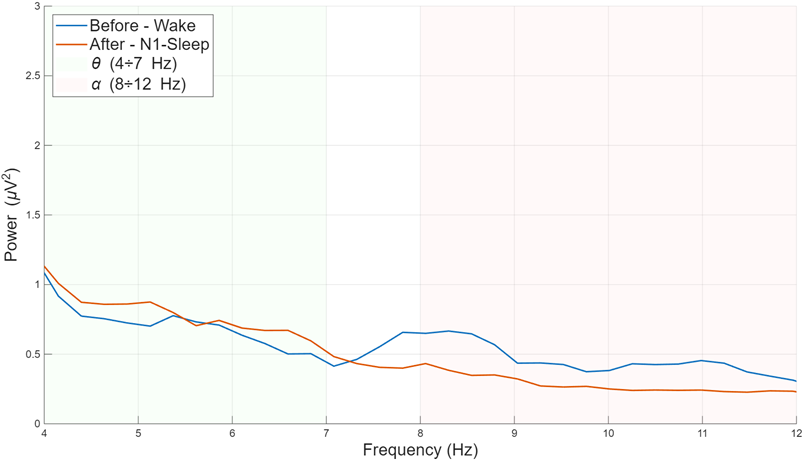
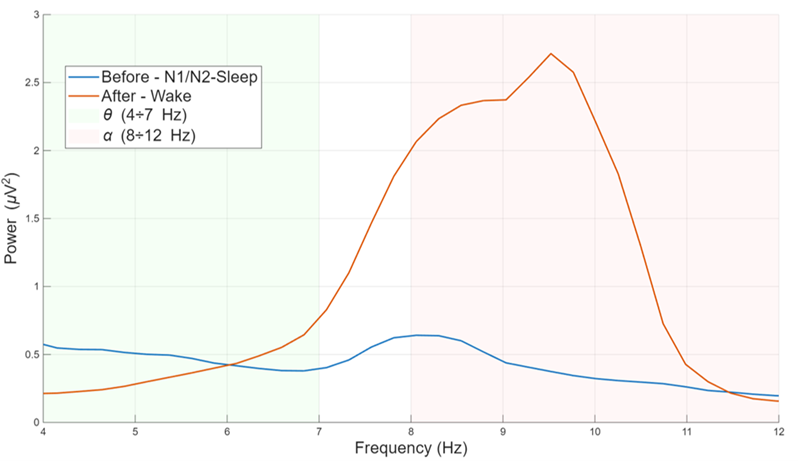
The spectral analysis of EEG signals highlighted systematic variations in energy distribution among different frequency bands during transitions between wakefulness and sleep.
Specifically, the transformations observed in the spectral content show a dynamic consistent with the hypothesis of coupling between oscillations at different temporal scales, suggesting the presence of energy transfer mechanisms between adjacent bands.
Overall, the results obtained appear compatible with the theoretical framework of the parametric resonance model, according to which brain oscillations can be interpreted as the product of collective processes of synchronization and dynamic amplification within the neuronal network.
In conclusion, the parametric resonance model of the brain represents a significant attempt to integrate concepts of nonlinear physics and complex systems theory into the understanding of neuronal processes.
This approach not only enriches our understanding of brain physiology but also opens new perspectives for the study of neurological pathologies and for the development of advanced computational models of the human brain.