INTERNATIONAL SCHOOL OF NONEQUILIBRIUM PHENOMENA
20th Course: NONEQUILIBRIUM COMPLEX SYSTEMS & TRANSITIONS: FROM BRAIN TO CLIMATE
Data: 26–29 June, 2026
Luogo: Erice, Trapani
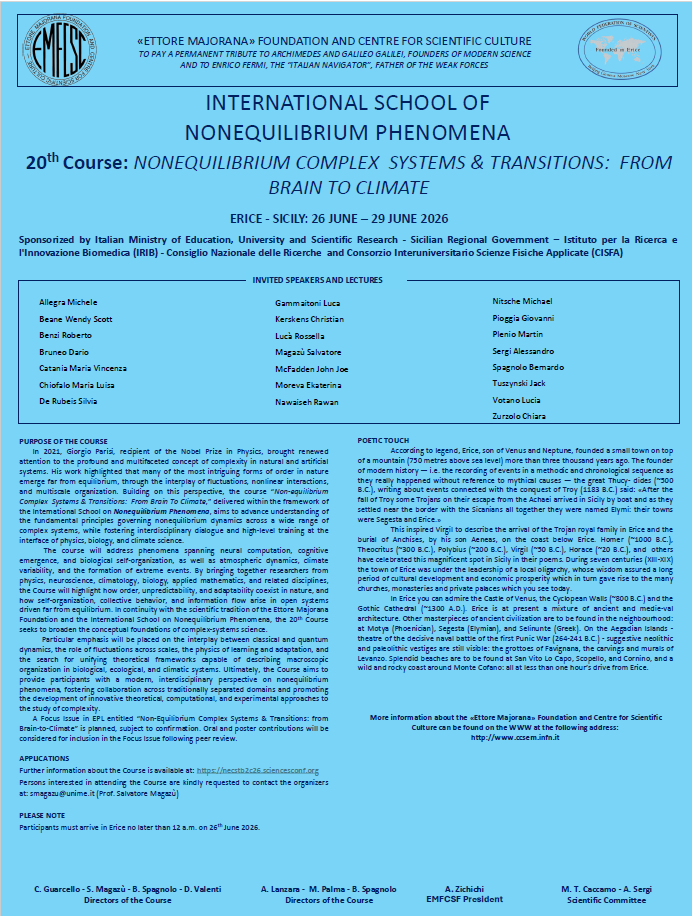
The International School of Nonequilibrium Phenomena is hosting its 20th course entitled “Nonequilibrium Complex Systems & Transitions: From Brain to Climate,” which will take place in Erice, Sicily (Italy), from June 26 to June 29, 2026. The course is organized by the “Ettore Majorana” Foundation and Centre for Scientific Culture, an institution dedicated to promoting scientific research, education, and international collaboration.
The program focuses on the study of nonequilibrium complex systems, exploring how order, structure, and collective behavior emerge in systems operating far from equilibrium. It addresses a broad range of interdisciplinary topics, including neural processes, biological self-organization, and climate dynamics, and brings together experts from physics, neuroscience, biology, climatology, and applied mathematics.
The course will address phenomena spanning neural computation, cognitive emergence, and biological self-organization, as well as atmospheric dynamics, climate variability, and the formation of extreme events. By bringing together researchers from physics, neuroscience, climatology, biology, applied mathematics, and related disciplines, the course will highlight how order, unpredictability, and adaptability coexist in nature, and how self-organization, collective behavior, and information flow arise in open systems driven far from equilibrium. In continuity with the scientific tradition of the Ettore Majorana Foundation and the International School on Nonequilibrium Phenomena, the 20th course seeks to broaden the conceptual foundations of complex-systems science.
Particular emphasis will be placed on the interplay between classical and quantum dynamics, the role of fluctuations across scales, the physics of learning and adaptation, and the search for unifying theoretical frameworks capable of describing macroscopic organization in biological, ecological, and climatic systems. Ultimately, the course aims to provide participants with a modern, interdisciplinary perspective on nonequilibrium phenomena, fostering collaboration across traditionally separated domains and promoting the development of innovative theoretical, computational, and experimental approaches to the study of complexity. A focus issue in EPL entitled “Non-Equilibrium Complex Systems & Transitions: from Brain-to-Climate” is planned, subject to confirmation, and oral and poster contributions will be considered for inclusion following peer review.
Locandina